|
The HFTA |
|
A guy
asked on the Swedish forum hififorum.nu if it was
possible to come up with a forum designed tube amplifier that is easy to
build and with reasonable power output. I decided to join in and contribute
with a design. My first idea was to use PL519 in screen driven mode but after
a while I changed to a more easily built design. One of my goals was to
reduce the number of low frequency poles to as few as possible. Tube
amplifiers with negative feedback are not known for their bass reproduction
and the reason is usually the excess amount of poles within the loop. A way to
get rid of poles is to use differential amplifier stages and DC connection
where possible. Thus, this amplifier is fully differential from input to
output. This first design is intended for unbalanced signal input and has a
single feedback network but it is easy to convert to differential input and
feedback (if the output transformer has a 16 ohm winding with 4 ohm tap).
There are only 2 low frequency poles in the loop, the transformer and the
coupling capacitors to the output tubes. While it is possible to DC connect
the output tubes it would complicate the power supply too much to be an
easily built design. The
design is a classical in disguise, a single input stage DC-connected to a cathodyne phase splitter much like my old EL34 design. I
replaced the single triode input with a differential stage with a constant
current sink in the tail. This stage takes over the role of phase splitting
from the cathodyne so it could be converted to a
fully differential stage with a resistor in the tail. These two stages are
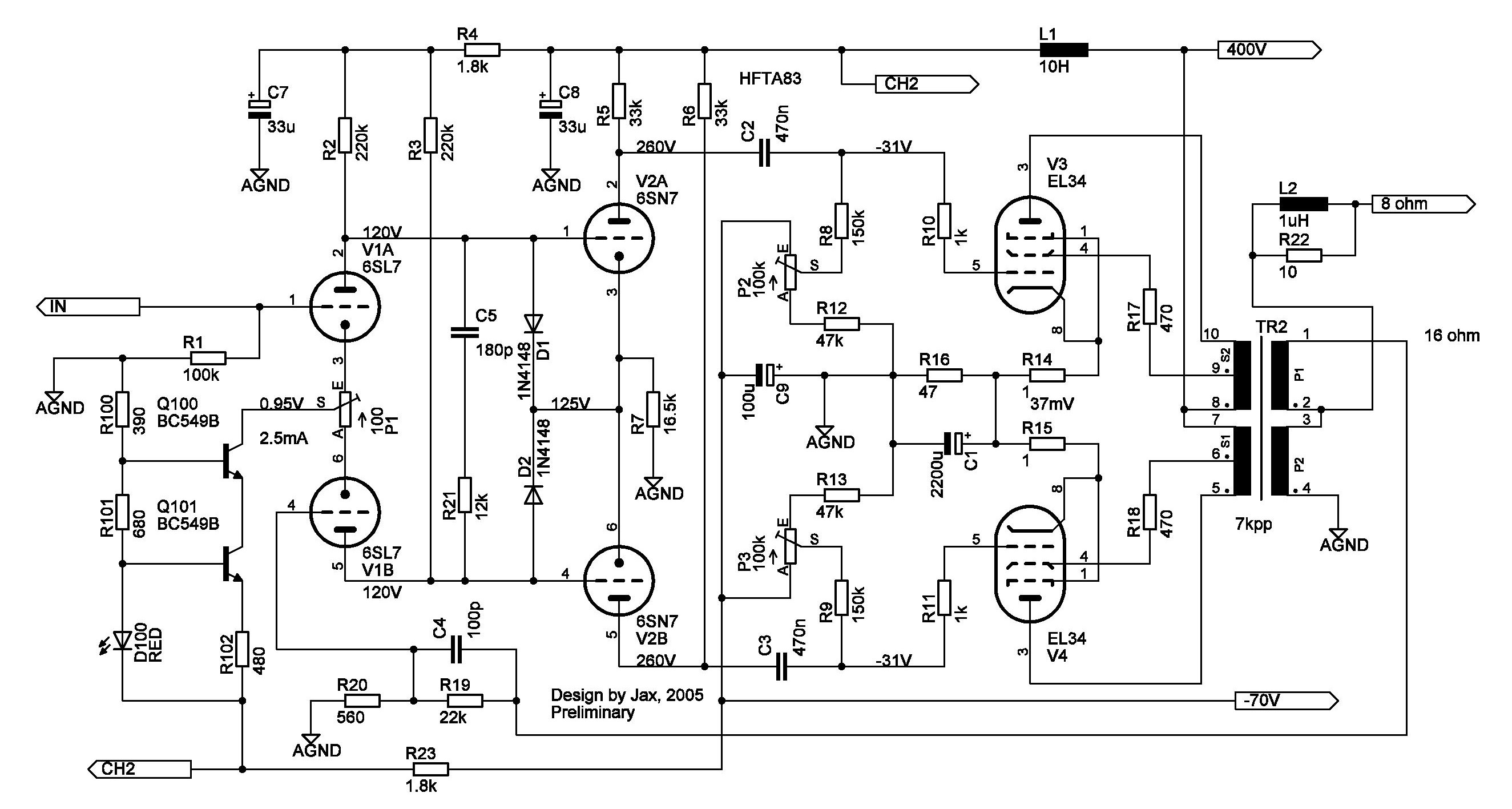
DC-coupled. Here is
the current schematic: (Note: Commercial use of this
design is not allowed without my permission)
Figure 1
Schematic of the HFTA2. The
schematic is still preliminary and subject to modifications but a prototype
is running and works just fine. A lot of measurements are left to do to
verify the design. This version has been built and was demonstrated at a DIY
meeting in Gothenburg Apr 2005. The tubes in the prototype are RCA 5691 for
V1, The input
stage uses 6SL7 and a constant current sink with two standard NPN transistors
in a cascode configuration and a red LED as
reference. The sink is set to 2.5mA with R102 which should be adjustable.
Input signal goes to the upper triode and feedback to the lower. P1 is used
to balance the stage. The choice to use semiconductors in the current sink is
based on the usage of a standard power transformer,
else a tube sink can be used here. The
driver stage is lifted up above ground to allow DC-connection to the input.
The diodes are for protection during warm-up, these
can be omitted if the power supply has slow start. While it is possible to
use a constant current sink here I decided that it was a bit over the top for
a simple design. I have found it to be the best to adjust P1 for a good
balance between the anodes of V2. The diodes on the driver
stage protects V2 during warm-up if the power supply has no delayed
HT. R21 and
C5 is the phase compensation for high frequency. It is set for output
transformers having its first HF pole around 53 kHz. C4 rounds off the HF
response to avoid ringing. The first pole is set to around 19.5kHz. Phase
margin is 70 degrees and the phase shift at 20kHz is 22 degrees. The
output stage is an ordinary fixed bias push-pull. With 7 kohm
output transformer and with bias at 37mA per tube, the output power is 30W,
all the way down to 20Hz. It’s not optimal yet, some adjustments will be
done. As said
above the design is in a preliminary stage. The bias network is a quick hack
using what I had in the junk box and will be redesigned. Nevertheless, the
amplifier sounds good and has a deep, quick and dry bass, very much unlike
classical designs that often have a fat and soft bass. Jazz music with double
bass is a joy to listen to. The highs are detailed and easy to listen to. |